
Case Study_
Key Highlights
- Legacy C2 systems force protection cells to operate on fragmented, manually reconciled data, leaving units unable to respond to shifting threats in real time.
- LMI built SHEPRD™ within IronSled™, our secure CMMC-accredited developer platform, to rapidly deliver a real-time common operating picture for protection cell efforts.
- In partnership with Anduril, LMI integrated SHEPRD with the Lattice Mesh network and deployed it onto Palantir’s Apollo platform, where it became fully operational during Ivy Sting 4 and 5.
- SHEPRD's unified dashboard enabled protection cells to make real-time adjustments to defensive posture across the battlespace.
Operating without a unified view of the battlespace
In large-scale combat operations, protection cells play a critical role, safeguarding troops and assets, anticipating threats, and coordinating defensive actions across contested environments. On the ground, multiple units operate simultaneously — convoys navigate uncertain routes, patrols maneuver between key positions, and recon teams survey terrain.
Each is vulnerable to constantly shifting threats, where even small gaps in awareness can leave positions exposed or compromise tactical assets.
Yet many of today’s command and control (C2) systems rely on fragmented systems and manual data reconciliation, which lack speed and real-time data synthesis, forcing teams to operate with an incomplete picture and increasing risk.
This challenge is not isolated to protection cells and reflects a broader limitation in how C2 systems have been built and deployed across the force.
The Army’s shift to NGC2
To address this, the Army is rethinking how C2 capabilities are delivered through the Next Generation Command and Control (NGC2) initiative, moving away from monolithic systems toward a modular architecture with an integrated data layer built to connect Army formations in real time.
Anduril is leading the development of the NGC2 architecture, creating a unified environment where mission applications can integrate directly and exchange data in real time. The result is a shared, continuously updated operational picture, enabling faster coordination, quicker adaptation to threats, and more synchronized action across the battlespace.
This model allows new capabilities to be developed, integrated, and deployed rapidly, ensuring the ecosystem can evolve at the pace of mission needs.
A protection platform built for operational reality
LMI recognized the need for a more integrated protection capability and built SHEPRD, a centralized platform that delivers a real-time common operating picture to protection cells for planning and execution.
LMI built SHEPRD within IronSled, our secure CMMC-accredited developer platform, enabling the team to test and deploy within accredited environments, avoiding delays that often stall operational adoption.
SHEPRD integrates disparate data sources and applies automated, risk-based prioritization and optimization to recommend protection tasking and allocate resources dynamically as mission conditions evolve.
In practice, the platform operates as a digital shield for the battlespace, bringing together threat intelligence, asset locations, terrain, routes, and protection coverage into a single operational picture. This enables protection cells to synchronize defense actions and shift from reactive defense to proactive protection.
SHEPRD in Ivy Sting
The Army’s Ivy Sting exercise series evaluates emerging C2 capabilities under realistic, high-pressure conditions. Conducted by the 4th Infantry Division in a secure, classified environment, these exercises simulate the complexity of modern warfare, where distributed forces, airspace operations, and logistics must be coordinated in real time.
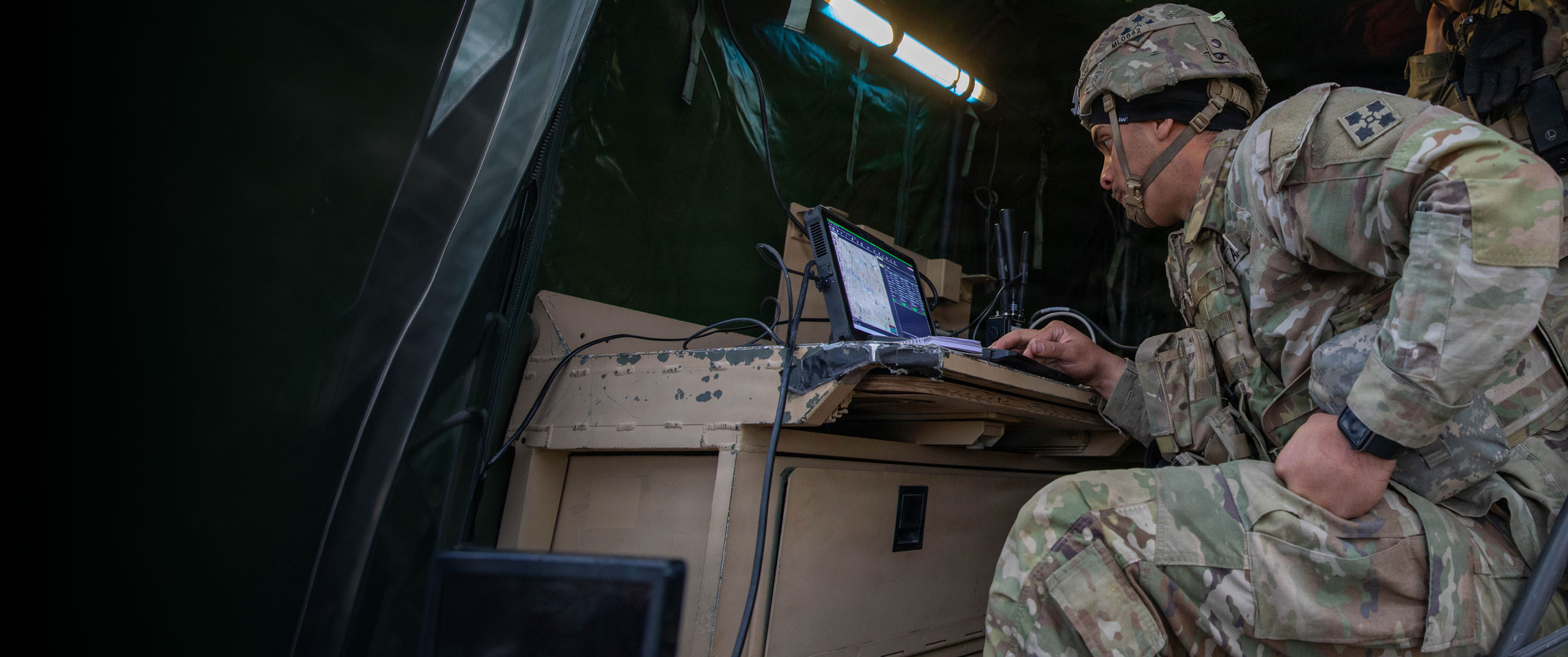
In partnership with Anduril, LMI integrated SHEPRD with the Lattice Mesh network and deployed it onto Palantir’s Apollo platform as a key application within the NGC2 ecosystem, where it became fully operational during Ivy Sting 4 and 5. LMI engineers worked side-by-side with Soldiers during the exercises, incorporating direct user feedback and refining the platform in real time.
This on-the-ground iteration showed how LMI builds capabilities for real-world conditions that can be rapidly deployed, made operational within a secure, connected architecture, and adapted as mission demands evolve.
SHEPRD delivers mission impact for protection cells
SHEPRD's performance during Ivy Sting demonstrated a shift from manual coordination to data-driven protection operations. With access to integrated data, real-time visibility, and aligned tasking, protection cells operated with greater speed, clarity, and coordination in high-tempo scenarios.
- Accelerated decision-making: Real-time 3D visualization replaced manual reconciliation, enabling faster identification of threats and quicker defensive responses.
- Unified common operating picture: Integrated data streams allowed teams to identify gaps, reprioritize assets, and maintain consistent protection across the battlespace.
- Adaptive defense posture: Protection plans could be adjusted in real time, moving from static planning cycles to continuous, responsive risk management.
- Optimized resource allocation: Commanders gained clearer visibility into where protection assets were most needed, improving the effectiveness and efficiency in the field.
- Synchronized execution: Protection activities were aligned to ensure coverage was coordinated, deconflicted, and executed in step with the operational timeline.
SHEPRD and the NGC2 ecosystem deliver the situational awareness and synchronization at the pace needed to safeguard combat power. Together, they demonstrate what decision advantage can look like in the Army’s modernized C2 architecture, while keeping the force safer on the battlefield.
Modernizing C2 for what comes next
Building on the momentum of Ivy Sting 5, the Army will continue testing and scaling NGC2 capabilities through upcoming exercises in 2026, including Ivy Mass and Project Convergence Capstone 6. LMI and Anduril have launched a Rapid Development Pilot to extend this model, focused on developing and deploying additional mission applications within the NGC2 ecosystem on compressed timelines. This reflects a broader shift in capability delivery, where software is continuously developed, deployed, and refined in near-real time through close collaboration with operators.
As NGC2 scales, platforms like SHEPRD are positioned to evolve alongside mission demands, adapting to new data, new threats, and new operational constraints. The result is a more responsive, integrated approach to C2, one where capability keeps pace with the environment it is designed to support.